Visiting Louvre Abu Dhabi: your guide
Louvre Abu Dhabi is a waterfront art and civilization museum best known for Jean Nouvel’s vast dome and its cross-cultural collection arranged by theme rather than country. The visit feels calmer and more spacious than many big-name museums, but it still rewards a plan because the route is chronological and the most memorable architecture sits partly outside the galleries. The biggest difference between a rushed visit and a good one is leaving time for both the permanent collection and the outdoor dome walk. This guide covers timing, entry, route, and what not to miss.
Quick overview: Louvre Abu Dhabi at a glance
If you want the short version before you book, start here.
- When to visit: Tuesday–Thursday: 10am–6:30pm; Friday–Sunday: 10am–8:30pm; Monday: closed. Tuesday or Wednesday from 10am to 12 noon is noticeably calmer than Friday evening, because weekend visitors linger under the dome once the heat drops.
- Getting in: From AED 70 for standard entry. Guided tour from AED 600 per group of 25, with admission booked separately. Midweek walk-up entry is often fine, but weekends and major temporary exhibitions are safer booked a few days ahead.
- How long to allow: 2–3 hours for most visitors. It pushes toward 4 hours if you want the full permanent route, the outdoor installations, and a proper stop under the dome.
- What most people miss: Giuseppe Penone’s Germination in the outdoor plaza and Maha Malluh’s Al Mu’allaqat, which many people walk past while moving quickly between headline works.
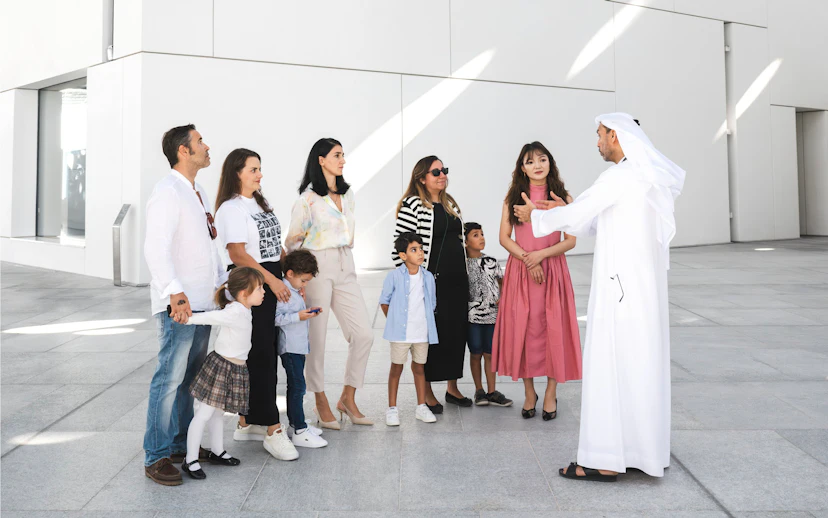
- Is a guide worth it? Yes if you want help understanding the museum’s cross-civilizational story, but for a self-paced visit the free app Audioguide gives enough context for much less effort.
Jump to what you need
🕒 Where and when to go
🗓️ How much time do you need?
🎟️ Which ticket is right for you?
🗺️ Getting around
🖼️ What to see
♿ Facilities and accessibility
Where and when to go
How do you get to Louvre Abu Dhabi?
The museum sits on Saadiyat Island, about 15 minutes by car from central Abu Dhabi and close to the rest of the city’s main cultural stops.
Saadiyat Cultural District, Saadiyat Island, Abu Dhabi, United Arab Emirates
- Bus: Route 94 → Louvre Abu Dhabi stop → 2-minute walk → the most direct public transport option from downtown Abu Dhabi.
- Taxi / rideshare: Main visitor drop-off → 1-minute walk → the easiest option from the Corniche, Qasr Al Watan, or the Grand Mosque area.
- Car: On-site parking → short walk to the entrance → simplest choice if you’re pairing Saadiyat stops in one day.
Getting here from nearby cities
Louvre Abu Dhabi works well as a cultural day trip, and Dubai is the most common outside base.
From Dubai
- Distance: 140km
- Travel time: 1.5–2 hours via E11 by car, or longer by coach plus taxi
- Time to budget: An early start still leaves you 3–4 hours at the museum without rushing the main galleries
From Al Ain
- Distance: 160km
- Travel time: About 2 hours by car
- Time to budget: Best treated as a full-day outing rather than a quick half-day museum stop
Which entrance should you use?
There is one main visitor entrance, and the mistake people make is arriving late in the day assuming they have until closing time for the galleries. In practice, gallery viewing ends earlier than many visitors expect.
- Located at the main museum forecourt on Saadiyat Island. Expect a 5–15-minute wait during Friday–Sunday afternoons.
When is Louvre Abu Dhabi open?
- Tuesday–Thursday: 10am–6:30pm
- Friday–Sunday: 10am–8:30pm
- Monday: Closed
- Dome plaza and outdoor public areas: Open until 12 midnight
- Last gallery entry: 30 minutes before closing
When is it busiest? Friday evenings, holiday periods, and special exhibition dates are the busiest windows, with heavier footfall around the dome and headline paintings.
When should you actually go? Midweek late mornings give you the easiest gallery pacing, while late afternoon is best if you care as much about the dome light as the art inside.
How much time do you need?
| Visit type | Route | Duration | Walking distance | What you get |
|---|---|---|---|---|
Highlights only | Dome plaza → early civilization galleries → Ramesses II → Renaissance galleries → Van Gogh → final gallery → exit | 1.5–2 hours | ~1.5km | You cover the architecture and the headline works, but you’ll move quickly and skip slower rooms, the Children’s Museum, and most outdoor details. |
Balanced visit | Dome plaza → full permanent gallery route in order → *Germination* → temporary exhibition if open → café or boutique | 2.5–3.5 hours | ~2.5km | This gives you the museum’s full narrative rather than just the star pieces, and the extra time is what makes the cross-cultural layout click. |
Full exploration | Outdoor dome walk → all permanent galleries → temporary exhibition → Children’s Museum → outdoor commissions → café or Fouquet’s → return under the dome | 4+ hours | ~3km | This is the most complete version of the visit, but it needs real stamina and only makes sense if you enjoy reading labels and lingering in quieter rooms. |
Which Louvre Abu Dhabi ticket is best for you
| Ticket type | What's included | Best for | Price range |
|---|---|---|---|
Skip-the-Line Tickets | Skip-the-line entry + permanent galleries + temporary exhibitions + dome plaza + Children’s Museum + museum boutique access + café access | A self-paced visit with full museum access, using the free app Audioguide for context | From AED 70 |
Combos | Skip-the-line entry to Louvre Abu Dhabi + access to another Abu Dhabi attraction (e.g., Qasr Al Watan, Warner Bros, etc.) | Visitors wanting to explore more of Abu Dhabi’s cultural sites with a single ticket | From AED 150 |
Guided Kayak Tour | Guided kayak tour around the Louvre Abu Dhabi + skip-the-line museum entry | Those seeking a unique perspective of the museum and a blend of adventure and culture | From AED 126 |
How do you get around Louvre Abu Dhabi?
Layout and suggested route
Louvre Abu Dhabi is a mostly linear museum with one main chronological path, so it’s easy to self-navigate once you’re inside. What matters in practice is not getting lost, but knowing when to pause, because the outdoor architecture and the quieter middle galleries are where rushed visits thin out.
- Permanent galleries → the core 12-chapter route from early civilizations to the global stage → budget 90–120 minutes.
- Temporary exhibition gallery → rotating show separate from the permanent arc → budget 20–40 minutes.
- Children’s Museum → compact family-focused space with interactive displays → budget 20–30 minutes.
- Dome plaza and outdoor commissions → shaded exterior walk with water views and installations like Germination → budget 20–30 minutes.
Suggested route: Start with the permanent galleries while your attention span is strongest, then move outside for the dome and Penone’s installation, and leave the final modern rooms for later rather than rushing straight to the photo spots.
Maps and navigation tools
- Map: Downloadable map and app-based guidance → covers the galleries and public spaces → best downloaded before arrival from the official museum site or app.
- Signage: Wayfinding is clear once you’re inside, but a map still helps because the outdoor installations and Children’s Museum sit slightly off the main rhythm.
- Audio guide / app: The free Louvre Abu Dhabi app adds multilingual commentary → access it on your own phone → worth using because the museum’s big idea is connection, not just object-by-object viewing.
💡 Pro tip: Download the app before you enter and bring your own earphones. The free Audioguide is one of the easiest ways to make sense of the museum’s themed layout without paying for a formal tour.
Where are the masterpieces inside Louvre Abu Dhabi?

Rain of Light dome
Creator: Jean Nouvel
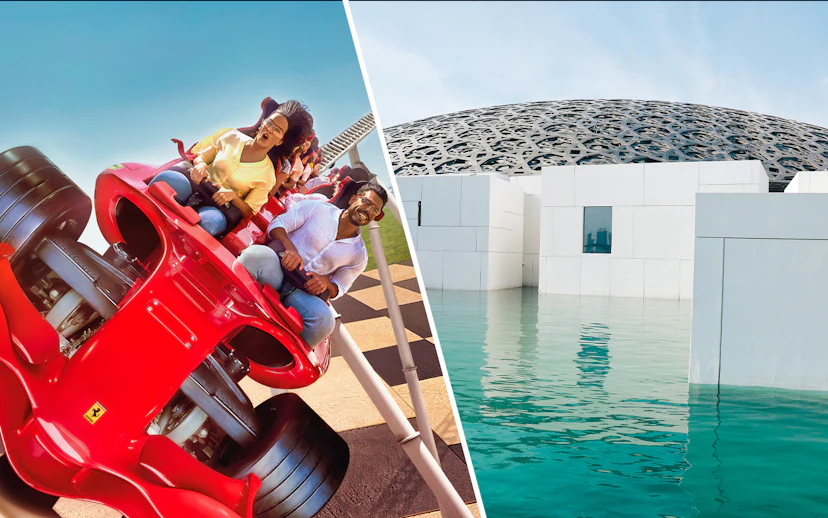
This is the museum’s defining space: a 180-meter lattice dome filtering sunlight into shifting patterns over water, walkways, and gallery roofs. It’s worth slowing down for because it changes by the hour, so the same space feels different in late morning and late afternoon. Most visitors photograph it quickly from the center and miss the side angles where the water reflections make the light pattern stronger.
Where to find it: Above the outdoor plaza and waterfront walk that links the museum’s gallery buildings.
Statue of King Ramesses II
Era: Ancient Egypt
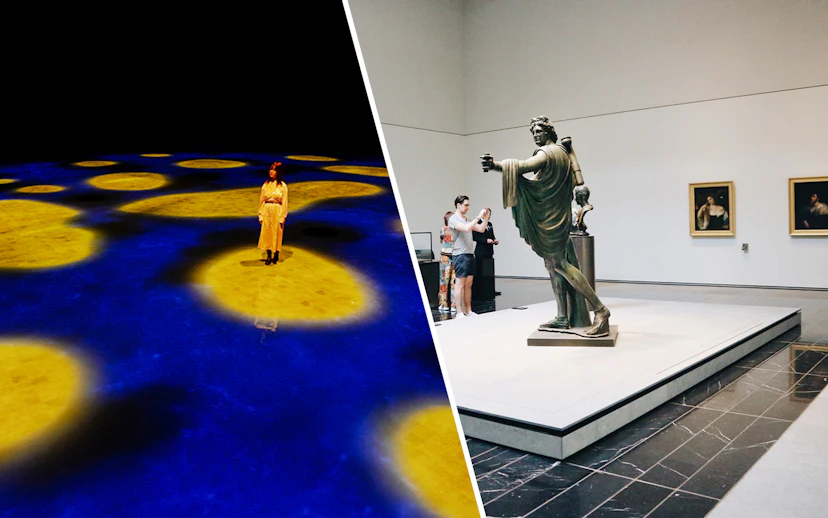
This black diorite pharaoh is one of the museum’s most commanding early works, and it gives real scale to the ‘first great powers’ section. It’s worth more than a passing look because it sets up the museum’s whole method of comparing civilizations side by side. Most people clock the size and move on, but the face and headdress details are what make it memorable.
Where to find it: Gallery 2, in the early civilizations section of the permanent route.
La Belle Ferronnière
Artist: Leonardo da Vinci
This portrait is one of the clearest links between Louvre Abu Dhabi and the Paris Louvre, and it’s one of the most-watched paintings in the museum. It rewards time because the appeal is in the restraint — the direct gaze, the clean profile, and the controlled use of light rather than obvious spectacle. Most visitors glance, snap a photo, and miss how small and intimate it actually is.
Where to find it: In the Renaissance galleries along the middle stretch of the permanent collection.
Van Gogh self-portrait
Artist: Vincent van Gogh
For many visitors, this is the painting they came for. It stands out because the museum places it within a broader modern narrative, so you see it in conversation with other late 19th-century works instead of as a one-off trophy piece. Most people focus only on the color and brushwork, but the context around it is what gives the gallery its payoff.
Where to find it: In the Modern World section toward the later part of the permanent route.
Germination
Artist: Giuseppe Penone
This outdoor commission matters because it ties the museum’s architecture, light, and place together better than almost anything inside. The bronze ‘tree of light’ and clay-based elements echo the dome’s filtered pattern and connect global art to local material. Most people pass it on the way out, but it makes more sense if you stop and look back toward the dome from beside it.
Where to find it: In the outdoor plaza spaces under the dome.
Fountain of Light
Artist: Ai Weiwei
This chandelier installation is the cleanest modern punctuation mark in the museum. It works as a finale because it shifts the visit from ancient objects and paintings into a broader reflection on power, spectacle, and global exchange. Most visitors reach it tired and rush through, but it lands best if you give it a final quiet minute before leaving.
Where to find it: In the last gallery, ‘A Global Stage’, at the end of the permanent route.
Facilities and accessibility
- 🍽️ Café / restaurant: The museum café is the practical quick-stop option, while Fouquet’s works better if you want a proper sit-down meal without leaving the complex.
- 🛍️ Gift shop / merchandise: The museum boutique is inside the complex and is strongest on art books, exhibition-linked gifts, and design objects rather than generic souvenirs.
- 🪑 Seating / rest areas: The shaded outdoor spaces under the dome make it easier to break up a 2–3 hour visit than in many enclosed museums.
- ♿ Mobility: Much of the museum is step-free and visitors regularly praise staff help with wheelchairs and golf-cart assistance, though the full route still involves a fair amount of walking between galleries and outdoor spaces.
- 👁️ Visual impairments: The free Audioguide app is the most useful built-in support for visitors with visual impairments, especially if you download it before arrival and bring your own earphones.
- 🧠 Cognitive and sensory needs: Tuesday and Wednesday late mornings are the calmest windows, while weekend evenings and special exhibitions are the noisiest and most stimulating parts of the visit.
- 👨👩👧 Families and strollers: The main route is generally stroller-friendly, and the separate Children’s Museum makes it easier to pace the visit in shorter, lower-pressure sections.
Louvre Abu Dhabi works well for school-age children because the building itself is visually engaging and the Children’s Museum gives them something designed at their pace rather than expecting them to follow the full adult route.
- 🕐 Time: 1.5–2 hours is realistic with younger children, and the best priorities are the dome, one run through the headline galleries, and the Children’s Museum.
- 🏠 Facilities: The biggest family advantage here is the dedicated Children’s Museum, which gives you a built-in break from the more label-heavy permanent route.
- 💡 Engagement: Use the museum as a spotting game by asking children to compare how different civilizations pictured rulers, animals, or daily life rather than trying to read every panel.
- 🎒 Logistics: Bring earphones if older children will use the free app, travel light because large bags are restricted, and aim for a morning or early-late-afternoon entry rather than the busiest evening window.
- 📍 After your visit: Saadiyat Beach is the easiest child-friendly reset nearby if you want open space after a museum-heavy part of the day.
Rules and restrictions
What you need to know before you go
- Buy a timed entry ticket if you’re visiting on a weekend or during a major exhibition, and bring government-issued photo ID if you’re claiming a free under-18 entry.
- Large bags are not allowed inside, so a small day bag is the least stressful way through security.
- Treat the visit as one continuous outing and use the on-site café or restaurant for breaks, because leaving mid-visit can cost you far more gallery time than people expect.
- There is no formal dress code, but lightweight indoor-outdoor layers help because you’ll move between air-conditioned galleries and the shaded open-air dome.
Not allowed
- 🚫 Food and drink are not allowed in the galleries, so eat before entry or plan around the museum café and Fouquet’s.
- 🐾 Pets are not allowed inside the museum spaces, and assistance needs are best arranged with the museum in advance.
- 🖐️ Touching artworks, barriers, or display cases is prohibited because many works are major loans and tightly protected.
Photography
Personal photography is one of the pleasures of visiting Louvre Abu Dhabi, especially under the dome, but the rules are more nuanced than ‘photos everywhere.’ In general, the dome and public spaces are photography-friendly, while flash, tripods, and selfie sticks are the items most likely to be restricted. Temporary exhibitions can also carry lender-specific rules, so check the signs at each gallery entrance rather than assuming the whole museum follows one blanket policy.
Good to know
- Galleries close 30 minutes before the museum’s stated closing time, which catches out late arrivals more than almost anything else.
- The free Audioguide is only as useful as your preparation, so download the app before you arrive and bring your own earphones.
Practical tips
- Book 1–3 days ahead for Friday–Sunday visits or major temporary exhibitions; midweek is more flexible, but late-day arrivals lose time fast because the galleries close 30 minutes before the posted museum closing time.
- Don’t rush straight to the dome and save the galleries for last if you care about the art: your attention is strongest early, and the outdoor architecture often looks better later in the day anyway.
- Tuesday and Wednesday from 10am to 12 noon are the easiest planning windows because the galleries stay quieter and you can see headline works like Leonardo and Van Gogh without the weekend photo clusters.
- Bring your own earphones and a small bag only; the app Audioguide is free, but large bags slow down entry and make a 2–3 hour museum visit more annoying than it needs to be.
- Eat either before entry or fully on site rather than stepping out midway; the museum café is the practical quick option, while Fouquet’s is better if you want to turn the visit into a longer cultural stop.
- If architecture is your priority, build in 20–30 minutes after the galleries just for the outdoor walk, because that is when people finally notice Germination and the best side views of the dome.
What else is worth visiting nearby?
Sheikh Zayed Grand Mosque
Distance: 17km — 15–20 minutes by car
Why people combine them: It gives you Abu Dhabi’s other major architecture-led cultural experience on the same day, and the contrast between sacred space and museum space works particularly well.
Qasr Al Watan
Distance: 17km — 15–20 minutes by car
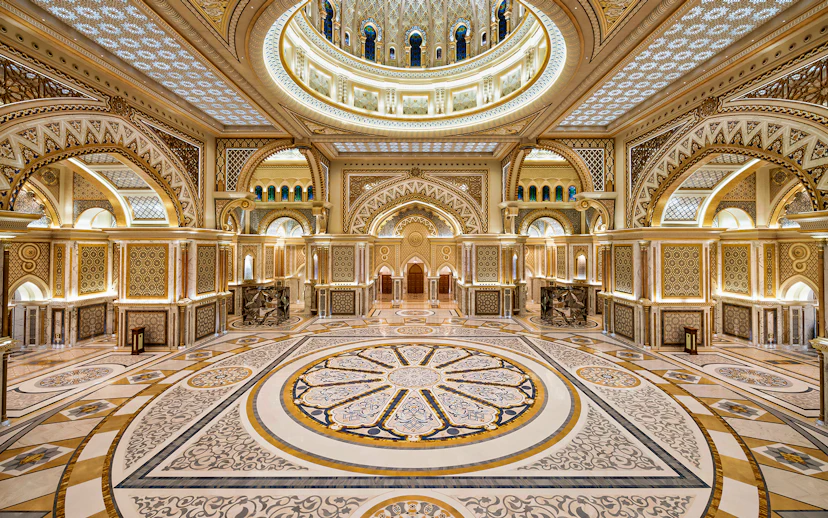
Why people combine them: It pairs naturally with Louvre Abu Dhabi if you want one day built around design, statecraft, and interiors rather than theme parks or desert activities.
Also nearby
Manarat Al Saadiyat
Distance: 3km — 5 minutes by car
Worth knowing: It’s a smaller contemporary arts stop, so it works best if you still have energy for one more cultural venue rather than a major second attraction.
Saadiyat Beach
Distance: 6km — 10 minutes by car
Worth knowing: This is the easiest nearby reset if you want open space, sea views, and a softer end to a museum-focused day.
Eat, shop and stay near Louvre Abu Dhabi
- On-site: The museum café and Fouquet’s cover the two useful extremes — quick coffee or a longer sit-down meal — and staying on site makes more sense than leaving midway through your visit.
- Fouquet’s Abu Dhabi (0-minute walk, inside Louvre Abu Dhabi): French brasserie, higher price point, best if you want a proper lunch or dinner without giving up museum time.
- Museum Café (0-minute walk, inside Louvre Abu Dhabi): Coffee, pastries, and lighter meals, mid-range, best for a fast break between the permanent galleries and the dome walk.
- Raclette Brasserie & Café (10-minute drive, Mamsha Al Saadiyat, Saadiyat Island): Casual European menu, mid-range, useful if you want a relaxed post-museum meal by the waterfront.
- Beirut Sur Mer (10-minute drive, Mamsha Al Saadiyat, Saadiyat Island): Lebanese food, mid-to-upper range, a strong pick if you want something more substantial after a shorter museum visit.
- Ting Irie Abu Dhabi (10-minute drive, Mamsha Al Saadiyat, Saadiyat Island): Jamaican menu, mid-range, worth considering if you want something less predictable than hotel dining nearby.
- Pro tip: If you plan to eat at Fouquet’s, make it your end-of-visit stop rather than a mid-visit break, because the museum flows better as one continuous route.
- Louvre Abu Dhabi Boutique: Art books, exhibition catalogs, design gifts, and museum-linked objects; it’s inside the complex and the most useful place for a souvenir that actually relates to what you saw.
- Mamsha Al Saadiyat retail strip: Casual lifestyle stores and beachside browsing on Saadiyat Island; better for a slow post-museum stroll than for serious shopping.
Saadiyat is a good base if you want a quieter, more polished Abu Dhabi stay with easy access to the museum and the beach. It is usually pricier than central neighborhoods, but it suits short cultural breaks especially well. If your trip is more about everyday city access and cheaper dining, downtown is the easier base.
- Price point: The area skews upper-mid-range to luxury, with resort hotels and beach properties doing most of the heavy lifting.
- Best for: Short stays where you want to keep Louvre Abu Dhabi, the beach, and a slower resort-style pace in the same part of the city.
- Consider instead: The Corniche or Al Zahiyah work better for longer stays, lower hotel costs, and easier access to the broader city without relying as heavily on taxis.
Frequently asked questions about visiting Louvre Abu Dhabi
Most visits take 2–3 hours, though 4 hours is realistic if you want the full permanent route, the outdoor dome walk, and a temporary exhibition. The difference comes down to whether you slow down for the museum’s narrative or just target the headline works like Leonardo, Van Gogh, and the architecture.
You don’t always need to book far ahead, but weekend visits and major temporary exhibitions are better booked at least a few days early. Midweek walk-up entry is often manageable, though advance booking still makes the day easier if you’re traveling on a fixed schedule.
Usually not, unless you’re visiting on a busy Friday–Sunday slot or during a high-interest special exhibition. Louvre Abu Dhabi is not a museum where standard queues dominate the whole experience, so the bigger win is choosing a good time of day rather than paying extra just to shave off a short wait.
Arrive 15–20 minutes early for a timed slot. That gives you enough buffer for ticket checks and security without standing around too long, and it matters most late in the day because the galleries close 30 minutes before the museum’s posted closing time.
Yes, but keep it small because large bags are not allowed inside the museum. A compact day bag makes the entry process smoother and is much easier to carry through a visit that usually lasts at least 2 hours.
Yes, personal photography is generally allowed, especially under the dome and in public areas, but flash and bulkier equipment are more restricted. Temporary exhibitions can also set their own rules, so always check the signs at the entrance to each show rather than assuming every gallery follows the same policy.
Yes, and the museum’s official Group ‘Express’ Tour is built for that, with a 45-minute educator-led format for up to 25 people. It’s a practical option if you want a structured highlights route instead of trying to keep a group moving at the same pace through the permanent galleries.
Yes, it works well for families, especially if you plan for a 1.5–2 hour visit and use the Children’s Museum as part of the route. The main mistake is trying to force younger children through every gallery in order when the better plan is a shorter highlights visit plus interactive time.
Yes, much of the museum is step-free, and visitors regularly mention helpful wheelchair and mobility assistance from staff. You should still expect a fair amount of distance between galleries and outdoor spaces, so build in breaks if you’re covering the full route.
Yes, you have both quick and sit-down options on site, plus more restaurants a short drive away on Saadiyat Island. The museum café is the practical fallback, while Fouquet’s suits a longer meal if you want to stay within the complex and avoid interrupting the visit.
Children under 18 can enter free, but you should still bring government-issued photo ID for them. This matters at the entry check, and it’s one of the small details that can slow families down if they assume free entry means no documentation is needed.
Mid-morning and late afternoon are the best times if you want to see the dome’s ‘rain of light’ at its most dramatic. Midweek is usually easier for photography because the outdoor plaza is calmer and you won’t be competing as much with weekend crowd flow.