How to visit Qasr Al Watan
Qasr Al Watan is a working presidential palace best known for opening real state spaces, not recreated rooms, to the public. The visit is more structured than a casual museum stop: you begin at the Visitor Centre, clear security, board an internal shuttle, and follow a defined route through ceremonial halls and exhibitions. The biggest mistake is treating it like a walk-up attraction. This guide covers timings, ticket choices, route planning, and the practical details that make the visit smoother.
Quick overview: Qasr Al Watan at a glance
If you want the short version before choosing a ticket, these are the details that most change the experience.
- When to visit: Daily entry windows vary by date, and Palace in Motion timings are updated monthly; late-afternoon weekday entries are noticeably calmer than winter weekend sunset slots, because most visitors want the palace interiors and evening show on the same ticket.
- Getting in: From AED 65 for standard entry. Guided tours from AED 30 as an add-on. Booking ahead is smart for your preferred entry window, especially in winter, but the bigger risk is schedule changes rather than constant hard sell-outs.
- How long to allow: 2–3 hours for most visitors. Stay closer to 3–4 hours if you want the library, slower exhibit time, exterior photos, and Palace in Motion.
- What most people miss: The Presidential Gifts exhibition and the House of Knowledge are where the palace becomes more than a photo stop, and the library is easy to miss if you leave it too late.
- Is a guide worth it? Yes, if you care about what the rooms mean rather than just how they look; if you mostly want the architecture and your own pace, the audio guide is the better-value option.
Jump to what you need
🕒 Where and when to go
🗓️ How much time do you need?
🎟️ Book your tickets
🗺️ Getting around
🏛️ What to see
♿ Facilities and accessibility
Where and when to go
How do you get to Qasr Al Watan?
Qasr Al Watan sits in Al Ras Al Akhdar at the western end of the Corniche, inside the Presidential Palace compound, and it is much easier to reach by car than by casual public transit.
Qasr Al Watan Visitor Centre, Al Ras Al Akhdar, Abu Dhabi, United Arab Emirates
- Taxi / ride-hail: Qasr Al Watan Visitor Centre → direct drop-off → the simplest option from the Corniche, Saadiyat, Yas Island, or the airport.
- Self-drive: Visitor Centre parking → free general parking → valet parking is listed at AED 35 on current FAQ pages.
- Organized tour transfer: Visitor Centre drop-off → best for Dubai day-trippers → saves you from managing a long inter-emirate transfer yourself.
Which entrance should you use?
The most common mistake is going to the palace façade instead of the Visitor Centre. All visitors start at the Visitor Centre, clear security there, and then take the internal shuttle into the palace complex.
- Pre-booked tickets: For online ticket holders. Expect 10–20 minutes across security and shuttle boarding during quieter periods, longer in winter afternoons.
- On-site purchase: For same-day buyers at the Visitor Centre. Expect 20–40 minutes when late-afternoon arrivals stack up before Palace in Motion.
When is Qasr Al Watan open?
- Daily: daytime entry windows vary by date and can change for operational reasons at this working government site.
- Palace in Motion: evening show timings are updated monthly and should be checked on the day.
- Last entry: follows the final ticketed slot for that date.
When is it busiest? Winter weekends, holidays, and late-afternoon arrivals from October to March are the busiest, because that is when visitors try to combine cooler weather, exterior photos, and the evening show.
When should you actually go? Choose a weekday late-afternoon slot if you want the full interior-plus-show version of the visit, or a summer morning if you only care about the indoor halls and want the lightest crowds.
How much time do you need?
| Visit type | Route | Duration | Walking distance | What you get |
|---|---|---|---|---|
Highlights only | Visitor Centre → Great Hall → Spirit of Collaboration → Presidential Banquet → exit | 1.5–2 hrs | ~1.5 km | You get the architectural payoff and strongest ceremonial rooms, but you will skim the exhibitions and miss much of the palace’s cultural context. |
Balanced visit | Visitor Centre → Great Hall → Spirit of Collaboration → Presidential Banquet → Presidential Gifts → House of Knowledge → exit | 2.5–3 hrs | ~2 km | This is the best first visit because it adds the rooms that explain diplomacy and governance without turning the stop into a slow museum afternoon. |
Full exploration | Visitor Centre → Great Hall → Spirit of Collaboration → Presidential Banquet → Presidential Gifts → House of Knowledge → Library → exterior grounds → Palace in Motion | 3.5–4 hrs | ~2.5 km | This gives you the full visual and intellectual arc of the palace, but it requires more patience, more standing time, and tighter timing if you want to stay for the evening show. |
How do you get around Qasr Al Watan?
Best explored on foot once the shuttle drops you off, Qasr Al Watan is compact enough for a 2–3 hour visit, but the size of the rooms makes it feel larger than it is. The Great Hall is your orientation anchor after arrival, and most public spaces branch outward from it, while the library is easier to miss if you leave it until the end.
Layout and route
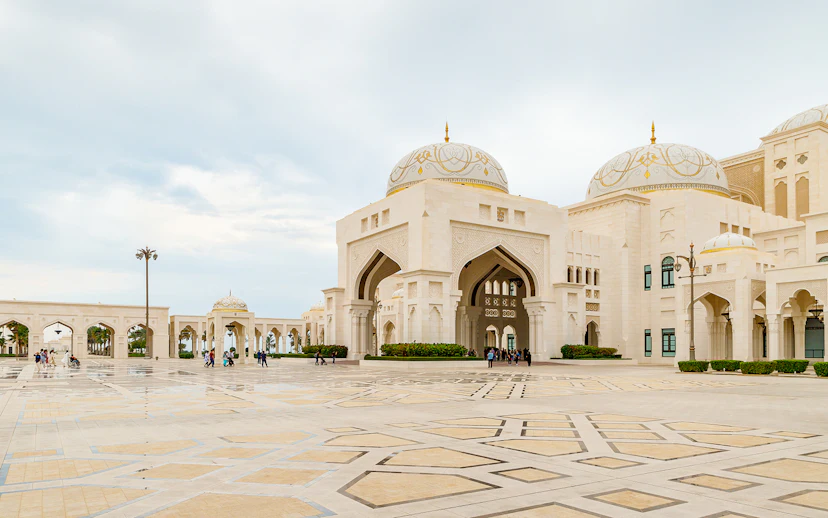
Qasr Al Watan is a zone-based palace visit built around the Great Hall, which works as both the visual centerpiece and the navigation hub. It is easy enough to self-navigate once you are inside, but it is also easy to walk straight to the obvious photo rooms and miss the parts that explain what the palace is for.
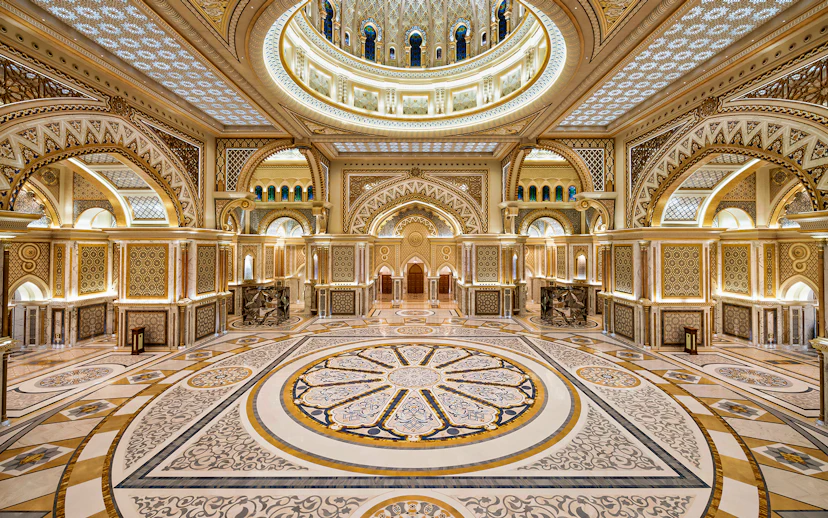
- Great Hall → the central arrival space and main dome → allow 15–25 minutes.
- Spirit of Collaboration and Presidential Banquet → the strongest ceremonial rooms → allow 20–30 minutes.
- Presidential Gifts → the clearest diplomacy-focused exhibition → allow 15–25 minutes.
- House of Knowledge → manuscripts, scholarship, and cultural context → allow 15–30 minutes.
- Library → the quietest and most reflective stop → allow 20–40 minutes.
Suggested route: do the Great Hall first, then the summit room and banquet while your energy is high, slow down for the gifts and House of Knowledge, and fit the library before exterior photos because its hours are narrower than the broader palace day.
Maps and navigation tools
- Map: On-site map and official wayfinding → covers the main palace route → pick it up at the Visitor Centre before boarding the shuttle.
- Signage: Good enough for the main ceremonial rooms → less strong for helping you decide what to prioritize → a map helps if the library matters to you.
- Audio guide / app: Available in Arabic, English, Mandarin, German, and Russian → adds real value in the exhibits → best if you want context without joining a live tour.
💡 Pro tip: Do not save the library for the very end. It keeps narrower hours than the main palace route, so it is the easiest worthwhile stop to miss if you drift outside for photos too early.
What are the most significant spaces in Qasr Al Watan?

Great Hall
Room type: Ceremonial hall
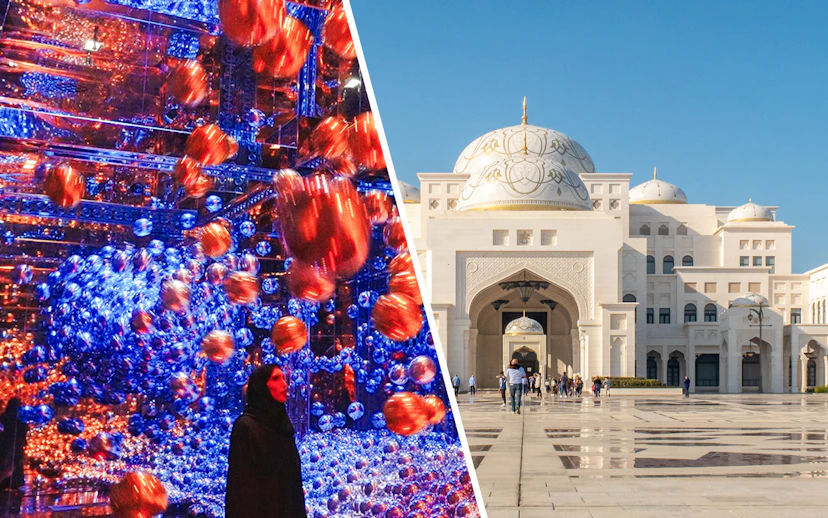
This is the visual anchor of the entire visit and the room most people picture afterward. The scale, patterned marble, and giant dome deliver the immediate ‘this is why I came’ moment, but the mirrored cubes off the main axis are what many visitors rush past. Step into one and look back toward the center for the best sense of how the geometry is meant to frame the hall.
Where to find it: Immediately after the main palace entry, at the center of the visitor route.
Spirit of Collaboration
Room type: Summit chamber
This circular chamber is where the working-palace identity becomes most obvious. It is not just impressive; it explains how the palace functions, with the round layout signaling equality in high-level meetings rather than theatrical excess. Most visitors photograph the chandelier and move on too quickly — stand beneath it and look up before reading the room’s political symbolism.
Where to find it: Off the main ceremonial route branching from the Great Hall.
Presidential Banquet
Room type: State dining hall
The banquet room makes formal hospitality feel concrete rather than abstract. What slows visitors down here is not only the blue-and-gold palette, but the explanation of how state dining is staged, from seating logic to service scale. Many people focus on the room itself and miss that the table layout is part of the story, not just decoration.
Where to find it: On the main interior circuit after the summit chamber.
Presidential Gifts
Exhibition type: Diplomatic gifts gallery
This is one of the most underrated parts of the palace because it gives the strongest international dimension to the visit. The variety of objects is interesting on its own, but the real value is seeing what diplomatic gifts say about protocol, identity, and state relationships. People often breeze through for photos without reading labels, which is exactly where the meaning sits.
Where to find it: Along the exhibition route beyond the main ceremonial halls.
House of Knowledge
Exhibition type: Knowledge and manuscript gallery
This is where the visit stops feeling like pure architecture and starts feeling intellectually grounded. The focus on manuscripts, scholarship, and Arab-Islamic knowledge broadens the palace beyond ceremony, and it rewards a slower pace than the big rooms do. What many visitors miss is that this section changes the whole interpretation of the palace from spectacle to national storytelling.
Where to find it: In the exhibition wing reached after the ceremonial rooms.
Qasr Al Watan Library
Space type: Public library
The library is quieter, calmer, and easier to skip than almost any other major stop, which is exactly why it is worth prioritizing if it matters to you. With about 50,000 titles, it reframes the palace as a place of research and public knowledge, not just diplomacy. The easy-to-miss detail is practical: its operating hours are narrower than the palace’s, so waiting until the end can backfire.
Where to find it: In the library zone within the wider palace complex, reached from the exhibition route.
Palace in Motion
Experience type: Evening projection show
This short exterior show is not a full nighttime program, but it is a strong finish if you have timed your visit well. The real value is not length — it runs for about 15 minutes — but seeing the façade used as a storytelling surface after spending time inside. Many visitors assume it is a separate-ticket event only, even though general admission includes it when it is operating.
Where to find it: Outside on the palace façade area after your interior visit.
Facilities and accessibility
- 🚻 Restrooms: Toilets are available at the Visitor Centre, Zayed Gate, and inside the palace, so you do not need to leave the compound for a basic stop.
- 🍽️ Cafe: Diyafa is available near the palace and Visitor Centre exit areas for coffee and light food, but eating is restricted to designated restaurant areas and gardens.
- 🛍️ Gift shop: The main retail stop sits on the exit flow, which makes it easy to browse at the end without backtracking into the visit.
- 🅿️ Parking: Parking at the Visitor Centre is free, and current FAQ pages also list valet parking at AED 35.
- ♿ Mobility: The palace is wheelchair and stroller accessible, free wheelchairs are available, and the shuttle-based arrival saves you from a long outdoor walk from parking to the entrance.
- 👁️ Visual impairments: Audio guide support is available in 5 languages, but specialist visual-access tools are not prominently published, so this works best as an audio-supported rather than tactile visit.
- 🧠 Cognitive and sensory needs: The quietest version of the visit is usually a weekday daytime slot, while security, shuttle boarding, the Great Hall, and Palace in Motion are the loudest and busiest points.
- 👨👩👧 Families and strollers: Strollers are available for AED 20, and the route is generally pram-friendly from the Visitor Centre through the main interior circuit.
Qasr Al Watan works best for school-age children and curious teens, because the scale, light, and diplomatic objects hold attention even when they do not read every label.
- 🕐 Time: 90 minutes to 2 hours is realistic with younger children, and the Great Hall, gifts gallery, and evening show give the strongest payoff.
- 🏠 Facilities: Restrooms are spread across the Visitor Centre and palace, and stroller rental helps if you do not want to carry one through security.
- 💡 Engagement: Turn the gifts gallery into a country-spotting game, because it gives children something concrete to look for in a venue that can otherwise feel formal.
- 🎒 Logistics: Bring a small bag, not a bulky one, and choose a late-afternoon slot only if your child can comfortably stay through the light show.
- 📍 After your visit: Emirates Palace Mandarin Oriental, Abu Dhabi is the easiest nearby follow-up for a short walk, snacks, or a change of pace.
Rules and restrictions
What you need to know before you go
- Entry requirement: Use a dated ticket and start at the Visitor Centre, not at the palace doors, and children up to the age of 11 years must be accompanied by an adult.
- Bag policy: Small day bags are the safest choice because there are no convenient large-bag lockers and oversize luggage can be refused at security.
- Re-entry policy: Re-entry is not permitted once you leave the palace building, so finish the library, gift shop decisions, and any evening-show plans before you exit.
- Dress guidance: Modest clothing that covers shoulders and knees is the safest choice at this government site, even though it is not a religious landmark.
Not allowed
- 🚫 Food and drink: Outside food and drink are restricted, and anything you buy on-site must be consumed only in designated restaurant areas and gardens.
- 🚬 Smoking and vaping: Smoking is restricted to designated areas only, so do not expect to step out casually and return mid-visit.
- 🐾 Pets: Pets are not allowed, while service-animal arrangements should be checked in advance with the venue.
- 🖐️ Behavior: Do not touch displays or cross barriers, because this is a high-security, operational government venue as well as a visitor attraction.
Photography
Personal photography is usually fine in the public halls and exterior areas, and that is a big part of the appeal here. The line becomes stricter with professional-style equipment: tripods and bulky setups can cause problems at security, and staff instructions override the general photo-friendly feel if rooms, routes, or exterior areas are being managed differently that day.
Good to know
- Your ticket may be checked more than once, so keep it accessible on your phone instead of buried in a bag.
- The palace and nearby Emirates Palace Mandarin Oriental, Abu Dhabi are separate places, so do not confuse a hotel photo stop with your booked palace visit.
Practical tips
- Book at least 1–3 days ahead if you want a late-afternoon winter slot, not because Qasr Al Watan always sells out far in advance, but because that is the most convenient window for combining interiors, façade photos, and the evening show.
- Arrive 20–30 minutes early at the Visitor Centre, and give yourself more buffer if you are carrying bags, because the real front-end friction here is security and shuttle boarding rather than the palace rooms themselves.
- Save your slower attention for the Presidential Gifts exhibition and House of Knowledge, because that is where the visit becomes more than a beautiful hall-to-hall photo walk.
- If you are choosing between off-peak and peak entry, remember that off-peak mainly affects when you can enter, not how long you can stay once inside; that matters if your whole plan depends on arriving near sunset.
- Bring a small bag and leave airport-style luggage elsewhere, because there are no reliable large-bag lockers and oversized bags can be refused outright.
- Eat before you enter or after you finish, not midway, because food is limited to designated restaurant areas and gardens and re-entry is not allowed once you leave the palace building.
- If Palace in Motion matters to you, verify that day’s show time close to travel, because monthly timing changes are more common here than at a standard museum.
What else is worth visiting nearby?
Commonly paired: Louvre Abu Dhabi
Louvre Abu Dhabi
Distance: 24 km — 30–35 min by car
Why people combine them: It makes a strong art-and-architecture day, with Louvre Abu Dhabi covering the global collection and Qasr Al Watan giving you the UAE-specific political and cultural context.
→ Book / Learn more
✨ Qasr Al Watan and Louvre Abu Dhabi are most commonly visited together — and simplest to do on a combo ticket. The combo keeps both cultural heavyweights on one booking and makes the day easier to structure than buying them separately. → See combo options
Commonly paired: Sheikh Zayed Grand Mosque
Sheikh Zayed Grand Mosque
Distance: 23 km — 25–30 min by car
Why people combine them: They answer different versions of the same Abu Dhabi question — one is the city’s defining religious landmark, and the other is its clearest governance-and-heritage visit.
→ Book / Learn more
Also nearby
Emirates Palace Mandarin Oriental, Abu Dhabi
Distance: 2 km — 5 min by car
Worth knowing: This is the easiest nearby stop for a polished coffee, a short walk, or hotel-lobby grandeur, but it is a luxury hotel, not a substitute for the palace visit.
Etihad Towers Observation Deck
Distance: 3 km — 6 min by car
Worth knowing: It works well if you want a second stop with a completely different payoff — skyline views instead of ceremonial interiors.
Eat, shop and stay near Qasr Al Watan
- On-site: Diyafa, near the palace and Visitor Centre exit areas, is good for coffee and light food in the mid-range, but it is more of a convenience stop than a destination meal.
- Emirates Palace Mandarin Oriental, Abu Dhabi (5-min drive, West Corniche Road): The easiest nearby upgrade if you want a fuller meal or café stop after the palace.
- Corniche cafés (10-min drive, Corniche Road): Better for a casual coffee or quick post-visit meal if you do not want to stay inside the palace compound.
- Marina Mall dining options (12-min drive, Marina Mall, Corniche Street): Useful for families or mixed groups who want easy, air-conditioned choice rather than a formal hotel setting.
- Pro tip: Eat before a late-afternoon visit or after Palace in Motion, because food is restricted during the main palace route and leaving early ends your visit for good.
- Qasr Al Watan gift shop: Located on the exit route, and the most useful place for palace-themed books, stationery, and formal souvenirs without adding a separate stop.
- Marina Mall: A practical follow-up if you want mainstream shopping rather than palace merchandise, especially after a half-day cultural itinerary.
Al Ras Al Akhdar is convenient for a polished short stay near the Corniche, but it is not the best all-purpose base for most Abu Dhabi trips. You will be close to Qasr Al Watan and nearby luxury hotels, yet farther from the wider mix of museums, beaches, and casual food options that most visitors use every day.
- Price point: This area skews upscale, with luxury hotels doing the heavy lifting rather than mid-range city stays.
- Best for: Short stays where walking distance to the Corniche end, easy taxi access, and a quieter government-district feel matter more than neighborhood variety.
- Consider instead: Stay on the Corniche for easier everyday dining and city access, or on Saadiyat Island if Louvre Abu Dhabi, beach time, and resort-style stays matter more to your trip.
Frequently asked questions about visiting Qasr Al Watan
Most visits take 2–3 hours. Plan closer to 3–4 hours if you want the library, slower time in the exhibitions, exterior photos, and Palace in Motion. A fast architecture-first loop can be done in about 90 minutes, but that is the version most likely to feel rushed.
No, you do not usually need to book weeks ahead, but booking in advance is still the smarter move. It helps you lock in the entry window you actually want, skip the ticket counter, and avoid last-minute confusion if timings change for operational reasons at this working government site.
Only partly, because prebooking skips the ticket counter rather than security itself. You still need to clear airport-style screening, board the internal shuttle, and pass ticket checks on the way in. It is worth it for smoother entry, but not if you expect a zero-wait arrival.
Arrive 20–30 minutes early at the Visitor Centre. Give yourself even more time if you are visiting in winter afternoons, carrying bags, or planning to arrive close to a Palace in Motion slot, because the front-end process here is stricter than at a normal museum.
A small day bag is usually fine, but large bags are a real problem. There are no convenient large-bag lockers, and oversized luggage can be refused at security. If you are coming from the airport or cruise terminal, store luggage elsewhere before you travel to the palace.
Yes, personal photography is generally allowed in the public palace areas. That said, professional-style gear is more sensitive here than at a casual attraction, and tripods can cause problems at security. Always follow staff instructions if any room or route is being managed differently on the day.
Yes, group visits are straightforward, and private guided formats are available for larger parties. The palace remains a public venue once you are inside, so a group booking does not turn the visit into a private after-hours experience, but it does help with pacing and interpretation.
Yes, especially for children who enjoy big spaces, lights, and visually striking interiors. Younger children usually do best with a 90-minute to 2-hour visit focused on the Great Hall, the gifts gallery, and the evening show. Children up to the age of 11 years must be accompanied by an adult.
Yes, the site is wheelchair accessible and free wheelchairs are available. The shuttle-based arrival also helps reduce the amount of outdoor walking between parking and the palace. It is still a large site with security stages, so allow a little extra time rather than planning a tight arrival.
Yes, but food works better before or after the main visit than during it. On-site options are available near the palace and Visitor Centre exit areas, and anything you buy must be eaten in designated restaurant zones or gardens rather than inside the ceremonial halls and exhibitions.
Yes, on-site purchase is possible, but online booking is the safer choice. It removes the ticket-counter step and gives you better control over your entry window. The bigger reason to book ahead is certainty and cleaner planning, not fear that tickets always sell out far in advance.
It usually means your entry is restricted to a cheaper, less popular time window rather than a shorter visit once you are inside. That distinction matters, because many first-timers think off-peak means they must leave early. If your day depends on sunset or Palace in Motion, read the entry window carefully before booking.